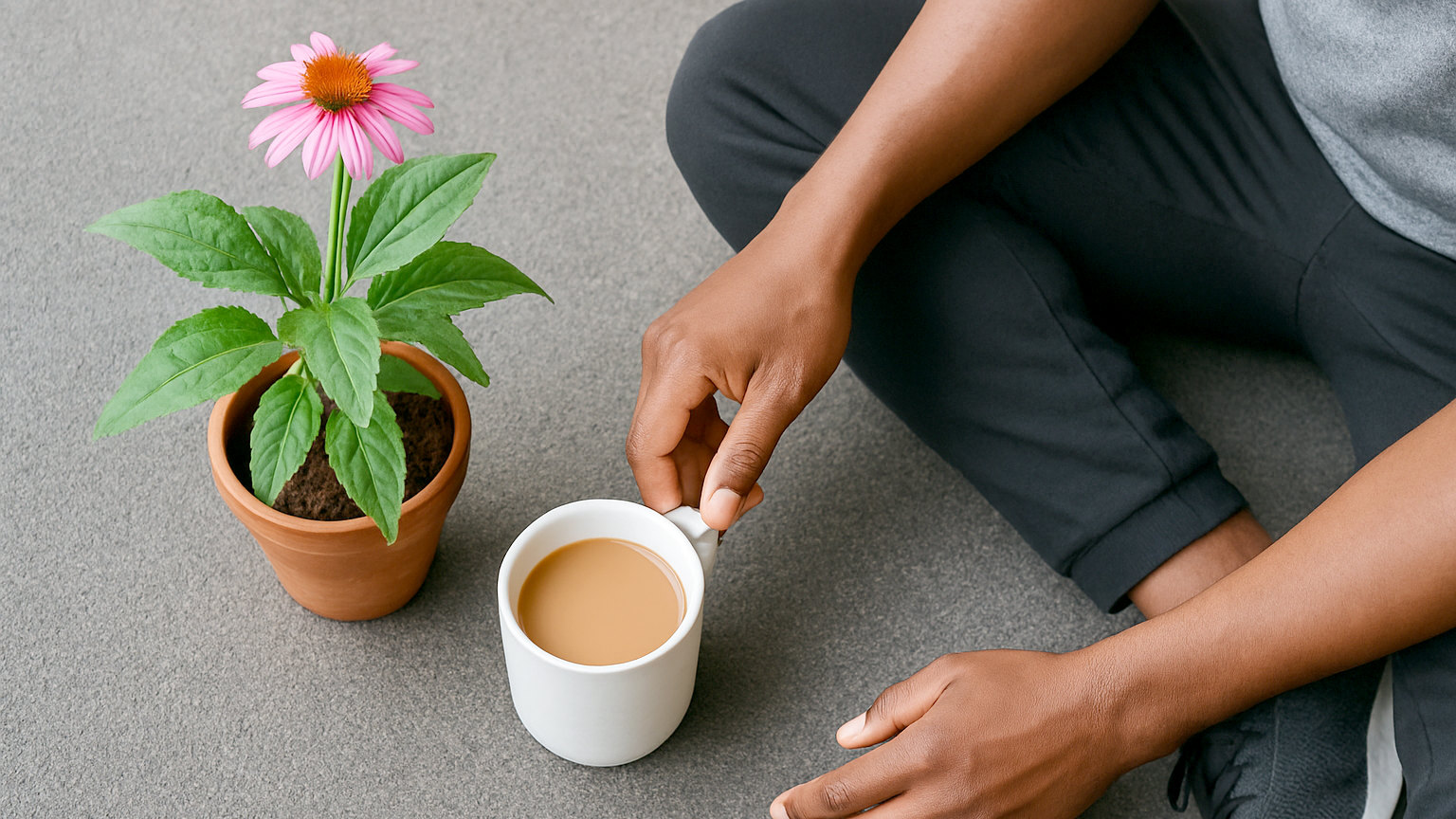
Echinacea is the herbal supplement most associated with colds, and the research on it is a good illustration of why herbal trials so often disagree.
What is echinacea?
A group of North American coneflowers, with three species used medicinally: Echinacea purpurea, angustifolia and pallida.
Different species and different plant parts are used in different products, which matters more than most buyers realise.
What do people take it for?
Preventing colds through winter, and shortening a cold already underway.
Some products extend the claim to general immune support, which covers the same ground more vaguely.
What does the research show?
Systematic reviews have concluded that echinacea products may reduce the risk of catching a cold slightly, with considerable uncertainty around the estimate.
Evidence for shortening an established cold has been inconsistent, with some trials reporting a modest reduction and others none.
Reviewers have repeatedly noted that the products tested varied so much that pooling them is difficult.
Why do the trials disagree?
Because echinacea is not one product. Trials have used pressed juice of the aerial parts, root tinctures, dried powder and various extracts.
These differ chemically, and a result for one preparation does not transfer to another.
Which part is used?
Echinacea purpurea preparations often use the flowering aerial parts, while angustifolia products more commonly use the root.
A label should state both the species and the plant part, and many do not.
What is the traditional registration?
Some echinacea products in the UK carry a traditional herbal registration for relieving common cold symptoms.
That assesses quality and safety rather than efficacy, and it does provide assurance about what is in the bottle.
How is it usually taken?
At the first sign of symptoms rather than continuously, several times daily for a short period.
Registered products generally advise a limit on how long echinacea should be taken without a break.
Who should avoid it?
- Anyone allergic to plants in the daisy family, including ragweed and chamomile
- People taking immunosuppressant medication
- Anyone with an autoimmune condition, on precautionary grounds
- Children, where products are age restricted
- Pregnant and breastfeeding women without advice
What are the side effects?
Stomach upset, nausea and rash are the most commonly reported, and allergic reactions have occurred.
Tinctures contain alcohol, which matters for some people.
What has better evidence for colds?
Handwashing, sleep and avoiding close contact when infectious.
Zinc lozenges started very early have some supporting evidence, at doses above daily limits and only for a few days.
When should you see a GP?
Breathlessness, chest pain, a cough lasting more than three weeks, or a fever that does not settle.
Is it worth trying?
Echinacea is low risk for most people and the evidence is weak, so expectations should be modest.
Choosing a registered product with the species and plant part stated is the sensible approach.
What is the summary?
Echinacea is taken for colds, reviews find weak and inconsistent evidence, and product variability is a large part of the reason.
This article is general information and not medical advice.
Why the duration limit?
Registered products generally advise not taking echinacea continuously for extended periods, partly because sustained immune stimulation has not been well studied.
Short courses at the onset of symptoms is the usual pattern.
What should you check on a label?
The species, the plant part, the preparation type and whether the product carries a traditional herbal registration.
Products stating only echinacea are telling you very little.
What does echinacea illustrate?
That a herbal name can cover several distinct products, and that pooling trials of different preparations produces uncertain conclusions.
The same problem affects most of the herbal literature.
Echinacea remains among the best selling herbal supplements in Britain each winter.
Its popularity has always outrun its evidence, which is not unusual in this category.
A pharmacist can advise on whether echinacea is suitable alongside anything you take.
The daisy family allergy is the check most worth making.