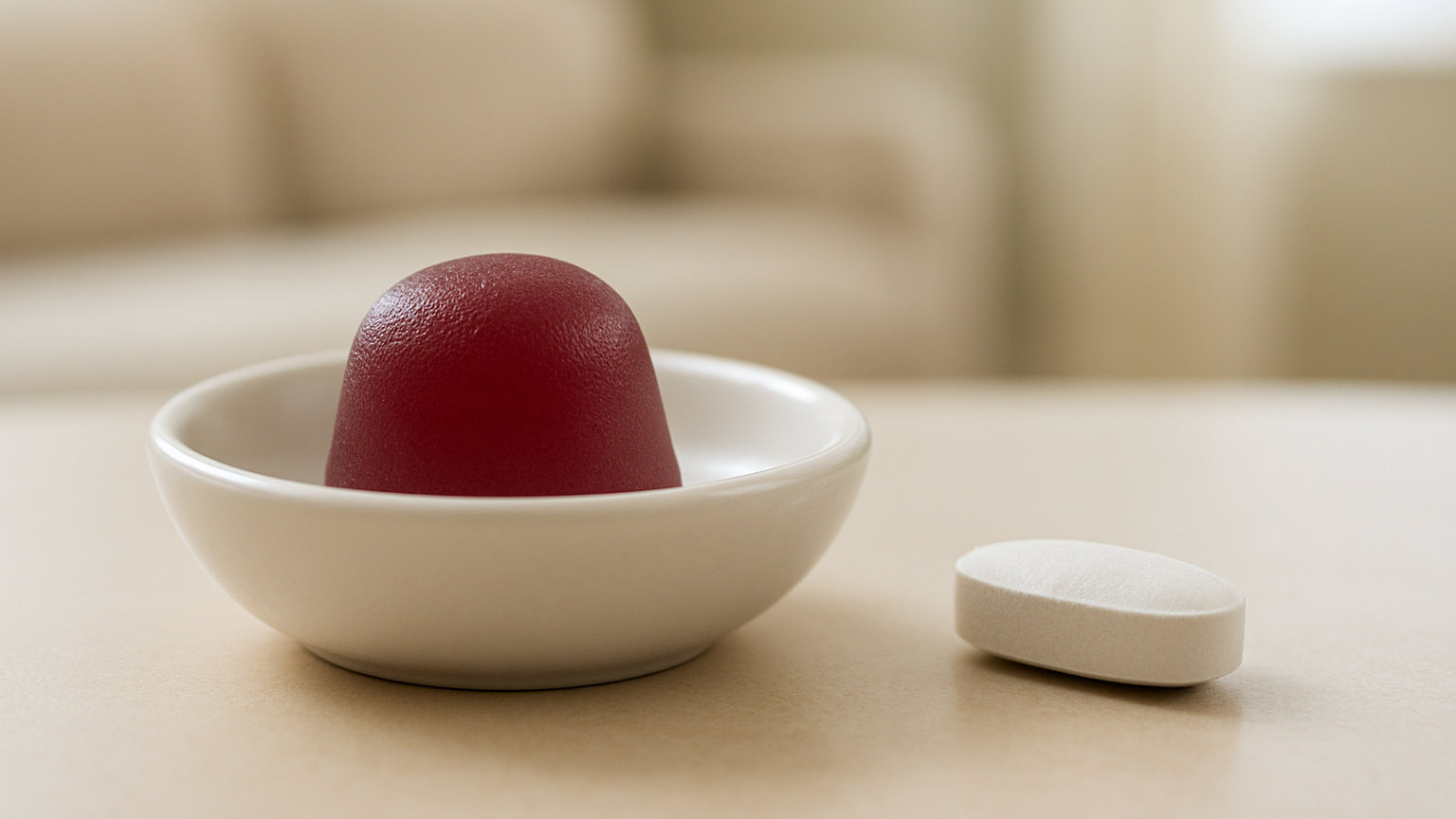
Gummy vitamins have become the fastest growing format in the supplement aisle, and they involve genuine trade offs. They generally contain fewer nutrients at lower doses, cost more per serving and add sugar. They also get taken, which is not a trivial advantage.
What is missing from gummies?
Iron is almost always absent, partly because it tastes metallic and partly because iron overdose is a leading cause of poisoning in young children and sweet formats are a poor vehicle for it.
Calcium and magnesium are usually absent or present in token amounts, because the quantities needed are physically too large for a sweet. Many gummies therefore contain a narrower range than an equivalent tablet.
A gummy multivitamin is generally not equivalent to a tablet multivitamin, and comparing labels directly is the only way to see what is actually there.
Do the doses match the label?
Less reliably than with tablets. Independent testing has repeatedly found gummy products containing more or less than stated, and the variation tends to be wider than for compressed tablets.
Manufacturers sometimes deliberately overfill at production to compensate for degradation over shelf life, which means the amount you get depends partly on how old the product is.
Nutrients degrade faster in gummies because of moisture content, heat exposure during manufacturing and greater surface contact with air.
How much sugar is involved?
Typically a few grams per serving, so two gummies might contain the sugar of a small sweet. That is modest in isolation and adds up daily over years.
Sugar free versions use sugar alcohols such as maltitol or xylitol, which can cause bloating and loose stools in some people at higher intakes. Xylitol is extremely toxic to dogs, which matters if you have one.
The sugar and acidity also have implications for teeth, particularly for children taking them daily and especially at bedtime.
What is the overconsumption risk?
This is the most serious practical concern. Gummies taste like sweets and are frequently stored where they can be reached.
Cases of children eating large quantities are well documented, and the fat soluble vitamins are the concern, since vitamin A and vitamin D accumulate rather than being excreted.
Store them out of reach and treat them as medicines rather than confectionery, regardless of what they taste like.
Is absorption any different?
- Chewing may modestly help by starting digestion earlier
- Fat soluble vitamins still benefit from being taken with food
- No consistent evidence shows gummies absorb better than tablets
- The gap between formats is smaller than the difference in what they contain
The absorption claims made for gummies are largely marketing. The real difference is composition rather than uptake.
When do they make sense?
When the alternative is nothing. For children, for people who cannot swallow tablets, for anyone with a strong aversion to them, and for those who will simply not maintain a tablet habit.
Compliance is a genuine factor, and a supplement taken daily in an imperfect format beats a better one sitting unopened in a cupboard.
What should you check?
Compare the nutrient list against a tablet rather than assuming equivalence. Check the serving size, since many require two or three gummies. Check the sugar content and where they will be stored.
For children, follow the age guidance on the packet and consider whether the UK vitamin D advice is separately met. This article is general information and not medical advice.
Are they suitable for adults?
Perfectly, with the same caveats. Adult gummy multivitamins exist and carry the same limitations on composition, dose accuracy and sugar content.
Many adults find them easier to maintain as a habit, and that is a legitimate reason to choose one provided the label is compared honestly against a tablet equivalent.
How should they be stored?
In a cool, dry place away from direct light, and out of reach of children. Heat and humidity accelerate nutrient degradation in gummies more than in tablets.
Avoid leaving them in a warm kitchen or a car. If they have become sticky, discoloured or clumped together, the nutrient content has likely degraded and they are worth replacing.