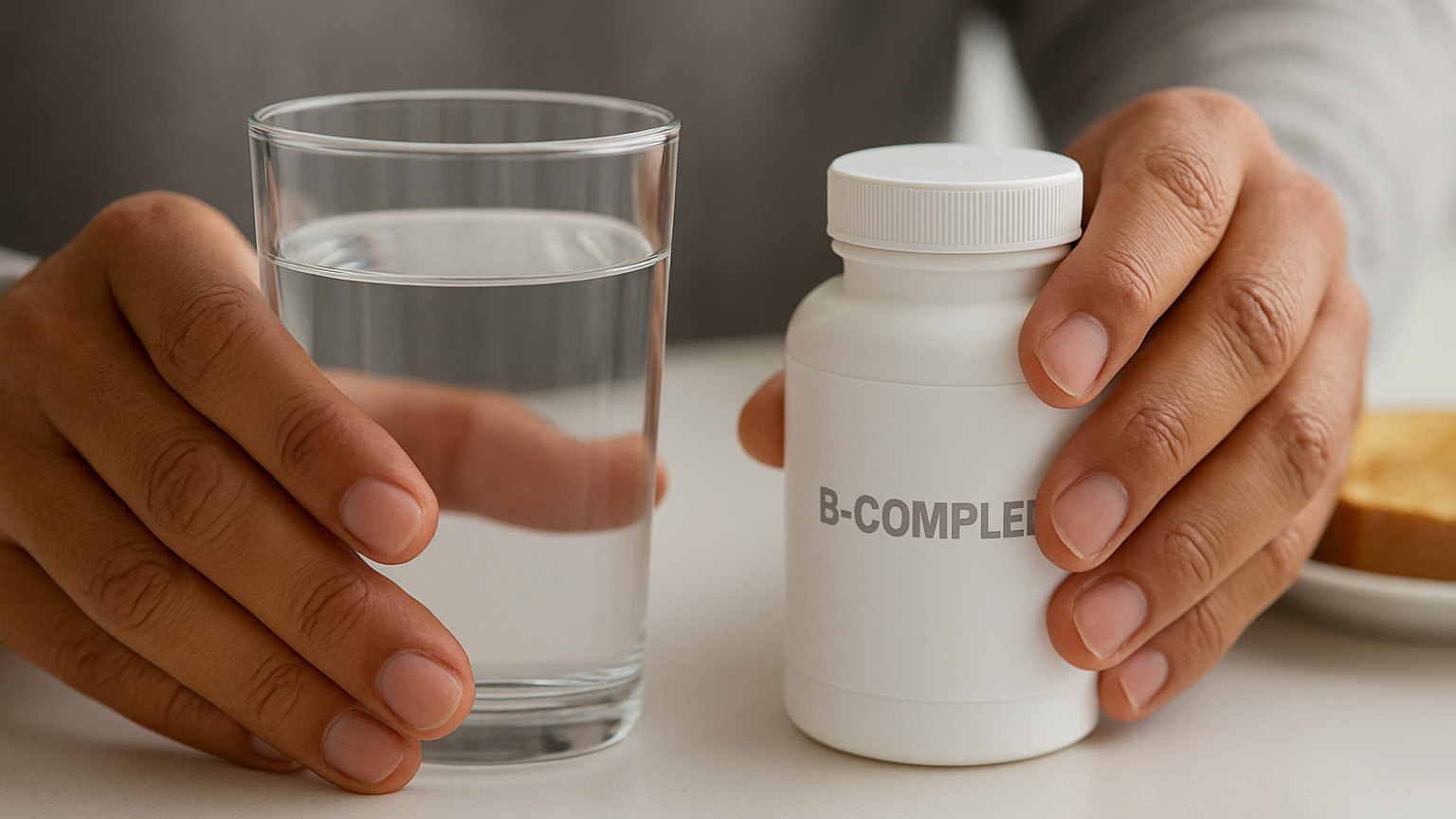
Take a B-complex and within a few hours your urine turns a striking fluorescent yellow. It is harmless, it is entirely expected, and it is frequently misread as evidence that the supplement is doing something. What it actually demonstrates is that a good deal of it left your body unused.
What causes the colour?
Riboflavin, vitamin B2, is itself a yellow pigment. The name comes from the Latin flavus, meaning yellow, and it is used as a food colouring under the code E101.
It also fluoresces, absorbing ultraviolet light and re-emitting it as visible yellow-green. That is why the colour looks unusually vivid rather than simply darker than normal.
Because riboflavin is water soluble and poorly stored, excess is filtered by the kidneys and excreted largely unchanged. The pigment arrives in urine intact.
Does it mean the supplement is working?
No, and this deserves stating plainly because the opposite belief is widespread.
The colour indicates excretion, not utilisation. Your body absorbed what it could use, saturated the relevant pathways, and disposed of the remainder. The brighter the colour, the more of the dose was surplus to requirement.
Riboflavin absorption is saturable, with the upper limit for a single dose commonly cited at around 27mg. Supplements frequently contain 50mg or 100mg, so most of it was never going to be absorbed.
Some manufacturers have used the colour as an informal selling point, since a visible effect feels like proof. It is one of the more effective pieces of accidental marketing in the supplement aisle.
How long does it last?
Usually a few hours, and up to about a day depending on dose and fluid intake. It clears as the excess works through.
Drinking more water dilutes the colour without changing how much riboflavin is excreted. If you take a complex daily, the effect will recur daily, which is entirely normal and not a sign that anything is accumulating.
The intensity varies with the dose. A modest multivitamin containing a few milligrams may produce barely any change, while a high strength complex containing 50mg or more produces the vivid version that prompts people to search for an explanation.
Should you worry about any urine colour change?
Bright yellow from B vitamins is benign. Other colours are worth attention.
- Pink, red or brown may indicate blood and should be assessed by a doctor promptly
- Dark brown or tea coloured can indicate liver problems or muscle breakdown
- Persistently dark yellow without supplements usually means dehydration
- Cloudy urine with burning or urgency suggests infection
Beetroot, rhubarb and some food dyes also colour urine harmlessly, which occasionally causes alarm. If in doubt about blood specifically, see a GP rather than assuming a dietary explanation.
What does riboflavin actually do?
It forms part of two coenzymes involved in energy release from food, in fat metabolism, and in recycling glutathione, one of the bodys main antioxidant systems. It is also needed to convert vitamin B6 and folate into their active forms.
Deficiency causes cracks at the corners of the mouth, a sore red tongue, sensitivity to light and sometimes a scaly rash. It is uncommon in the UK, since dairy, eggs, meat, mushrooms, almonds and fortified cereals all supply it.
Light degrades riboflavin, which is why milk sold in clear glass loses more of it than milk in opaque containers.
Is there a reason to take high dose riboflavin?
One, and it is reasonably well supported. Riboflavin at 400mg daily has been studied for migraine prevention, with several trials reporting a reduction in attack frequency after around three months.
The evidence is not uniform and the effect appears mainly on frequency rather than severity. It is inexpensive and well tolerated, and it is sometimes suggested by clinicians as an option worth trying.
At that dose the urine colour is dramatic. It remains a sign of excretion rather than of efficacy, though in this case the high dose is deliberate.
This article is general information and not medical advice. Discuss migraine treatment with a GP.