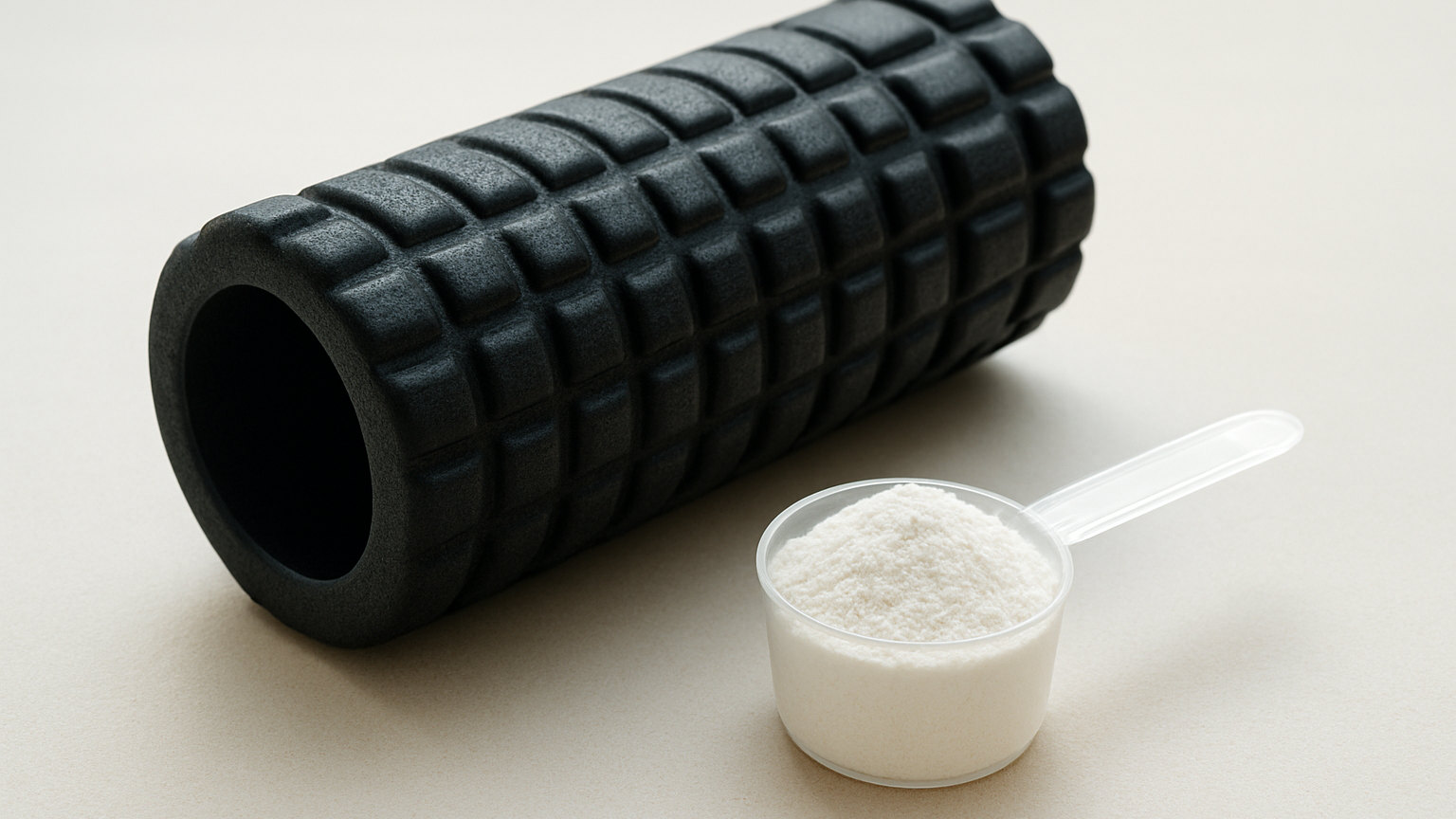
Foam rolling has better evidence than its more extravagant explanations would suggest. It does measurable things, and the mechanism is probably not the one printed on the packaging.
What does the research show?
Reviews have found foam rolling produces short term increases in range of motion, typically lasting minutes to perhaps half an hour.
Crucially, it does this without the temporary strength reduction that prolonged static stretching can cause, which makes it useful in a warm-up.
Studies have also reported modest reductions in perceived muscle soreness when used after exercise.
Does it release fascia?
Almost certainly not. The forces required to deform fascia meaningfully are far greater than a person can generate with body weight on a foam cylinder.
Fascia is remarkably strong tissue, and estimates of the force needed to produce lasting deformation exceed what rolling applies by a wide margin.
Terms like myofascial release describe a theory rather than a demonstrated process.
What is the likely mechanism?
Neural. Pressure and movement appear to alter pain perception and reduce the protective muscle tension that limits range of motion.
The short duration of the effect fits a neural explanation rather than a structural one, since genuine tissue change would not reverse within half an hour.
Effects on other body parts after rolling one limb have also been reported, which points towards a central rather than local mechanism.
What is it useful for?
- Warm-ups, where temporary range of motion increase is wanted without strength loss
- Reducing perceived soreness after training
- Working into stiff areas before mobility work
- Providing a routine that people find helpful
Does it do anything lasting?
Not on its own. Any lasting improvement in flexibility comes from stretching or loading through range over time.
Rolling before mobility work may allow better positions during that work, which could contribute indirectly.
Does it help performance?
Some studies have found small improvements in subsequent performance and many have found nothing. It does not appear to impair performance, which distinguishes it from prolonged static stretching.
How should you use it?
Around 30 to 60 seconds per area is typical in research protocols, with slow controlled movement rather than aggressive pressure.
It should be uncomfortable rather than painful. Rolling directly over joints, bones or areas of injury is not advisable.
What is the summary?
Genuine short term effects on range of motion and soreness, delivered through a neural mechanism rather than the fascial one usually claimed. Useful and modest.
This article is general information and not medical advice.
Does it hurt more than it should?
Some discomfort is expected and sharp pain is not. Rolling should be tolerable rather than an endurance test.
Aggressive pressure does not appear to produce better results and can cause bruising.
Is it worth buying one?
They are inexpensive and last indefinitely, which makes the cost benefit reasonable even for modest effects.
The expensive vibrating and textured versions have no demonstrated advantage over a basic cylinder.
What is the summary?
Genuine short term effects on range of motion and soreness, produced neurally rather than by releasing fascia. Cheap, harmless and modestly useful.
What does it not do?
It does not break up scar tissue, lengthen fascia, remove cellulite or correct postural problems, all of which appear in marketing.
Judging it by what it demonstrably does keeps expectations sensible.
How does it fit into a session?
Briefly before training as part of a warm-up, or afterwards if you find it eases stiffness. Neither placement appears to cause problems.
It is not a substitute for warming up properly through progressive movement.
Keeping one at home and using it briefly before sessions is a low cost habit that produces small but genuine benefits.
Anyone training twice a day should treat carbohydrate intake between sessions as a priority rather than an afterthought.
Using it for a couple of minutes before a session costs nothing and may improve how the first few sets feel.