Caffeine timing is more straightforward than most supplement timing questions, because it has a clear pharmacological basis. Blood levels peak at a reasonably predictable point after ingestion.
When does caffeine peak?
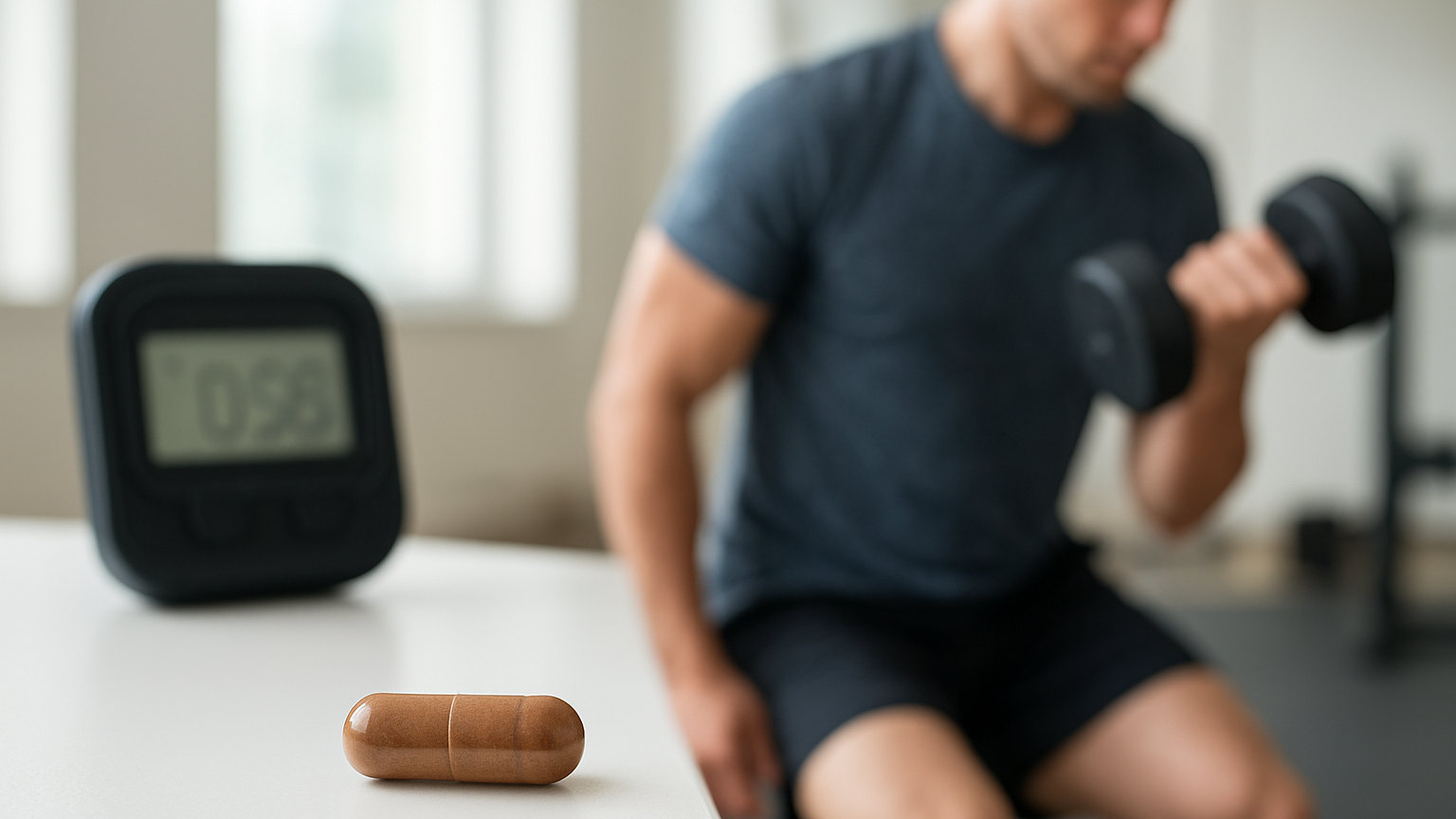
Blood concentrations generally peak around 45 to 60 minutes after taking it, which is why most research protocols use a 60 minute pre-exercise dose.
Absorption begins within minutes, so some effect is present well before the peak.
The half life is roughly four to six hours in most adults, meaning levels remain substantially elevated for hours afterwards. The window of benefit is therefore wide.
Does the form change the timing?
Somewhat. Caffeine gum is absorbed through the lining of the mouth and reaches peak levels faster, often within 10 to 20 minutes.
That makes gum useful for situations where a 60 minute lead time is impractical, such as taking caffeine partway through an event.
Capsules, tablets and coffee all follow broadly similar timelines, with liquid perhaps marginally faster than tablets.
Does food affect it?
Food slows absorption somewhat, delaying and slightly blunting the peak. It does not reduce the total amount absorbed.
Taking caffeine on an empty stomach produces a faster and sharper rise, which suits some people and causes discomfort in others.
If caffeine upsets your stomach, taking it with a small amount of food is a reasonable adjustment.
Can you take it during exercise?
Yes, and this is common in endurance events. Taking caffeine partway through a long event, often via gels or gum, produces benefits without requiring a large dose before the start.
Research on late race caffeine has found performance benefits even when taken well into an event, which fits the wide window.
How long does the effect last?
Performance benefits have been demonstrated several hours after ingestion, consistent with the half life.
For a long event, a single pre-race dose may cover much of it, though many athletes take additional smaller doses later.
What about morning training?
- Taking it on waking suits early sessions, since absorption begins quickly
- Some suggest delaying caffeine an hour after waking, though evidence for this is limited
- For very early training, the practical constraint is usually convenience rather than pharmacology
Does timing matter for sleep?
Considerably, and this is where timing genuinely matters most for most people. A study giving 400 milligrams six hours before bed found sleep reduced by around an hour.
Working backwards from bedtime is more important than optimising the pre-training window. Evening training with a caffeine dose is a common cause of poor sleep.
What is the practical approach?
Take it 45 to 60 minutes before training, adjust based on how you feel, and count backwards from bedtime to check it will have cleared sufficiently.
Test any strategy in training rather than on competition day. This article is general information and not medical advice.
Does timing matter for the size of the effect?
Less than you might expect, given the long half life. Taking it 30 minutes or 90 minutes before training produces broadly similar benefits.
The 60 minute figure comes from research convenience as much as from optimisation, which is worth knowing before rearranging your morning around it.
What about multiple doses?
Some athletes split a dose, taking part before and part during a long event. This maintains levels without a single large dose.
For sessions under an hour, a single dose beforehand is simpler and sufficient.
Should you take it on rest days?
There is no performance reason to. Habitual daily intake maintains tolerance, so some athletes reduce intake on rest days deliberately.
The evidence that this improves competition response is weak, and it costs nothing to try if you are curious.
What is the summary?
Take it 45 to 60 minutes before training, or use gum if you need it faster. The window is wide, so precision matters less than remembering to count backwards from bedtime.
Anyone training in the evening should weigh the performance benefit against the sleep cost, since the two frequently pull in opposite directions.