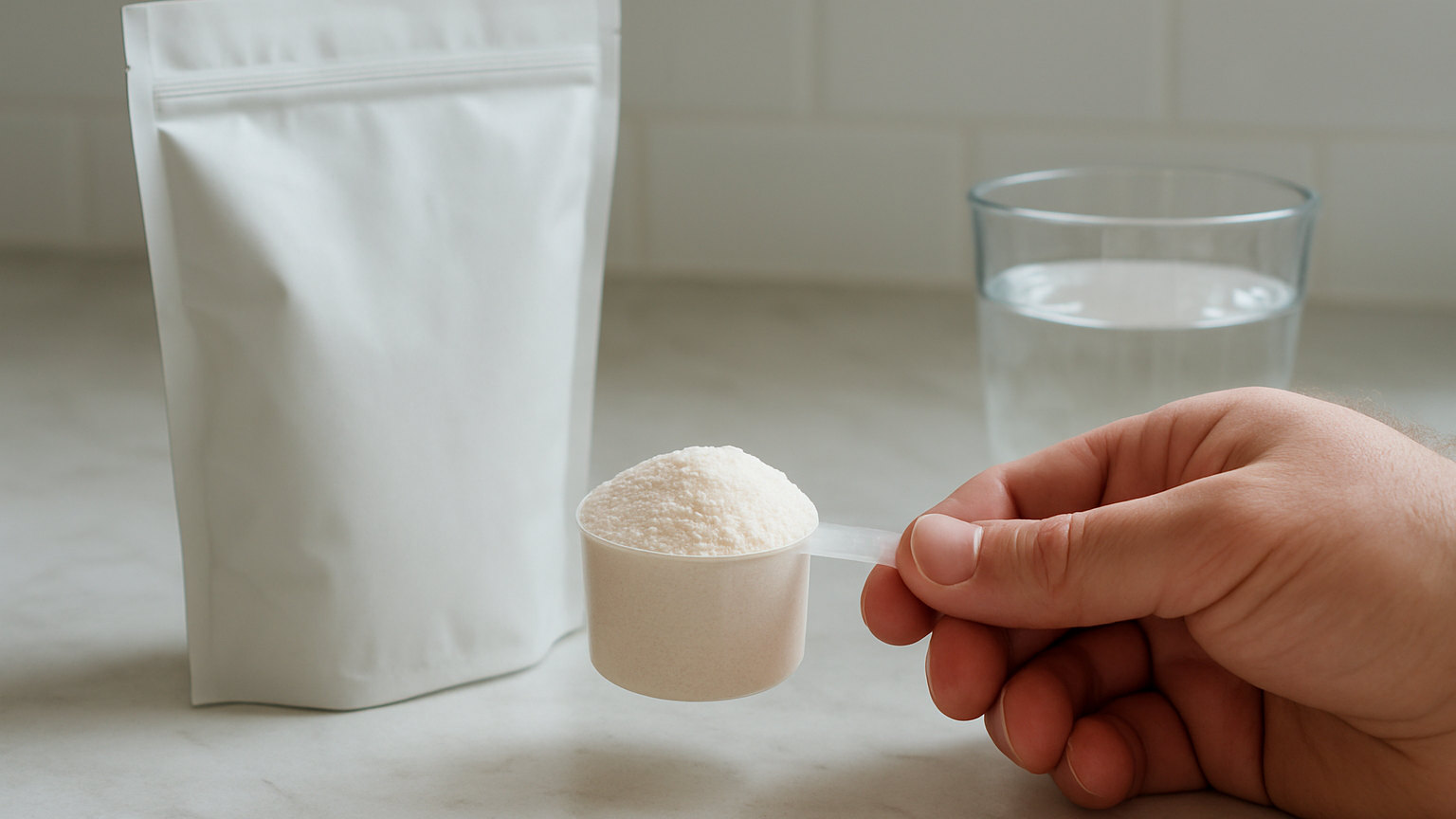
This is the question that determines whether BCAA supplements make sense, and for most people the answer is straightforward. If you eat adequate protein, you are already consuming plenty of BCAAs.
How much is in ordinary protein?
Whey protein is roughly 25 per cent BCAAs by weight. A 25 gram serving therefore supplies around 5 to 6 grams, including approximately 2.5 to 3 grams of leucine.
A chicken breast, a tin of tuna or three eggs each supply comparable amounts.
That already exceeds what a typical BCAA supplement serving provides, which is usually around 5 to 7 grams total.
What does adequate protein mean?
For someone training for muscle, around 1.6 grams per kilogram of body weight daily, which is where research finds gains plateau.
For a 75 kilogram person that is roughly 120 grams a day, supplying somewhere around 24 to 30 grams of BCAAs across the day without any supplement.
What does the research show?
Studies examining BCAA supplementation in people already consuming adequate protein have generally found no additional benefit for muscle mass or strength.
Reviews have concluded that BCAAs offer little to those meeting protein requirements, with the effects attributable to leucine already achieved through food.
Why do they not work alone?
Because muscle protein synthesis requires all nine essential amino acids. Leucine provides the signal, and the other eight provide the raw material.
Supplying BCAAs alone raises the signal without the materials to act on it. Research comparing BCAAs with whey found BCAAs produced roughly half the synthesis response.
Some researchers have argued that BCAAs alone may even be counterproductive, by driving synthesis without adequate substrate.
When might they be useful?
- Where protein intake is genuinely inadequate and cannot be improved
- In certain clinical situations including some liver conditions
- Where whole protein cannot be tolerated for medical reasons
- As a flavoured drink that encourages fluid intake during training
The clinical uses are genuine and distinct from the sports marketing.
What about the cost?
BCAA supplements are typically more expensive per gram of amino acid than whey protein, while supplying only three of the nine essentials.
Buying whey instead delivers all nine, including the BCAAs, usually at lower cost.
Are they harmful?
Not at typical doses. They are amino acids found in ordinary food, and the concern is cost and opportunity rather than safety.
What is the summary?
If you eat enough protein, BCAAs add nothing you were not already getting. Spending the same money on whole protein delivers more.
This article is general information and not medical advice.
What do the position stands say?
Sports nutrition bodies generally emphasise total protein intake and complete protein sources, with BCAAs receiving limited support as a standalone supplement.
Where amino acid supplementation is discussed, essential amino acids containing all nine are generally preferred over BCAAs.
How would you check your own intake?
Track what you eat honestly for three or four days and calculate grams of protein per kilogram of body weight.
Most people discover they are either comfortably adequate, in which case BCAAs add nothing, or well short, in which case more protein rather than BCAAs is the answer.
What is the practical conclusion?
Sort out total protein first. If it is adequate, BCAAs are redundant. If it is not, protein rather than BCAAs is the fix.
Very few people arrive at a situation where a BCAA supplement is the sensible response.
Why are they so popular then?
Because the leucine mechanism is genuine and easy to explain, and because a flavoured drink consumed during training feels productive.
Popularity in supplements correlates poorly with evidence, and this category illustrates that clearly.
What would change the answer?
A situation where complete protein cannot be consumed, whether through digestive intolerance, medical restriction or practical impossibility.
Those situations exist and are uncommon among people buying BCAAs at a gym.
The most common mistake is treating BCAAs as a protein substitute rather than a protein supplement, which leaves someone worse off than doing nothing.